
The English school system is now in the third decade of academy schools. But, where are we today and what might the future hold?
The pace of growth has slowed, so let’s dive into academy schools and trusts to reveal the picture in autumn 2026.
1. Academy schools today
The first academy school opened in 2002. During those early days, only secondary schools could become academies (and fewer than 200 of them did so).
From 2010, government policy changed and both primary and special schools could become academies too.
The number of academies for all types rose steeply.
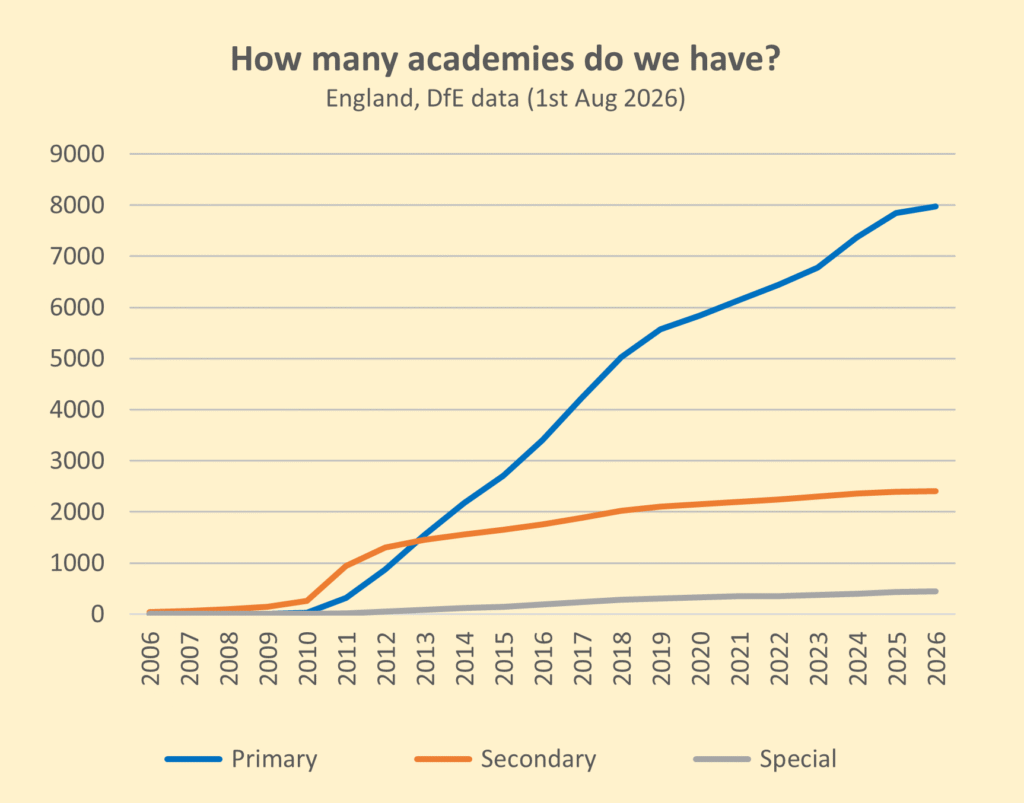
We now have over:
- 7,900 primary academies
- 2,400 secondaries academies
- 440 special school academies
2. Primary academy schools
Notes
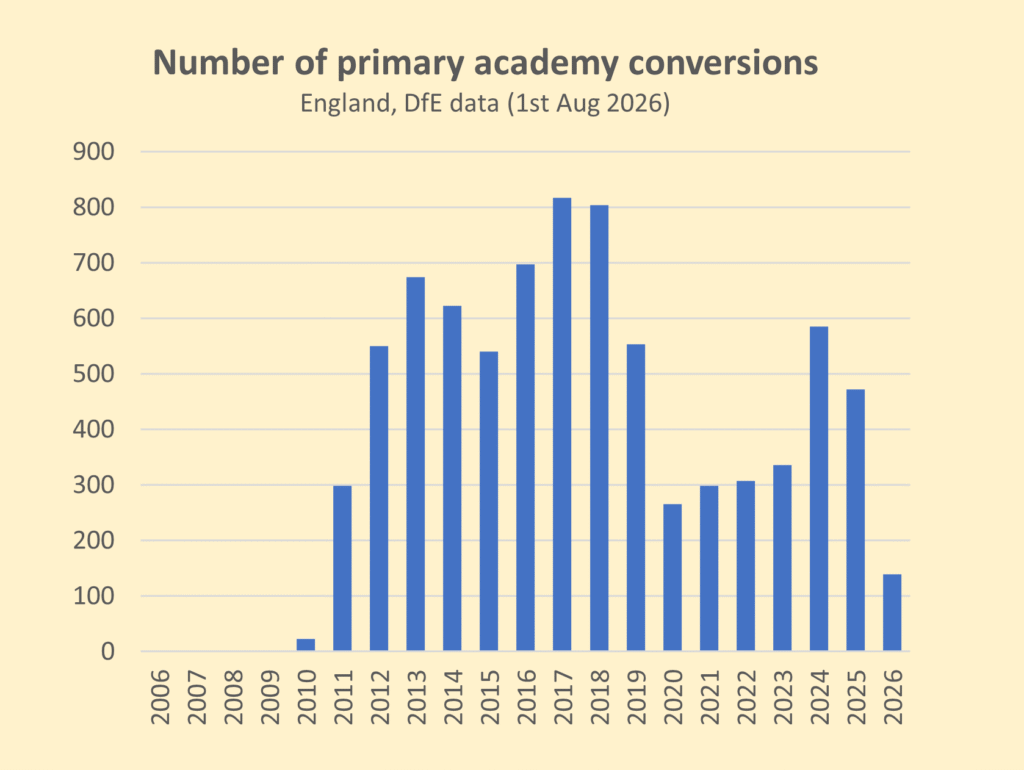
- 2026 is part year data.
- If academies change trusts, data shows when they last became a new academy (and not when they first became an academy).
- Sector graphs include both convertor and sponsored academies. Free schools are not included.
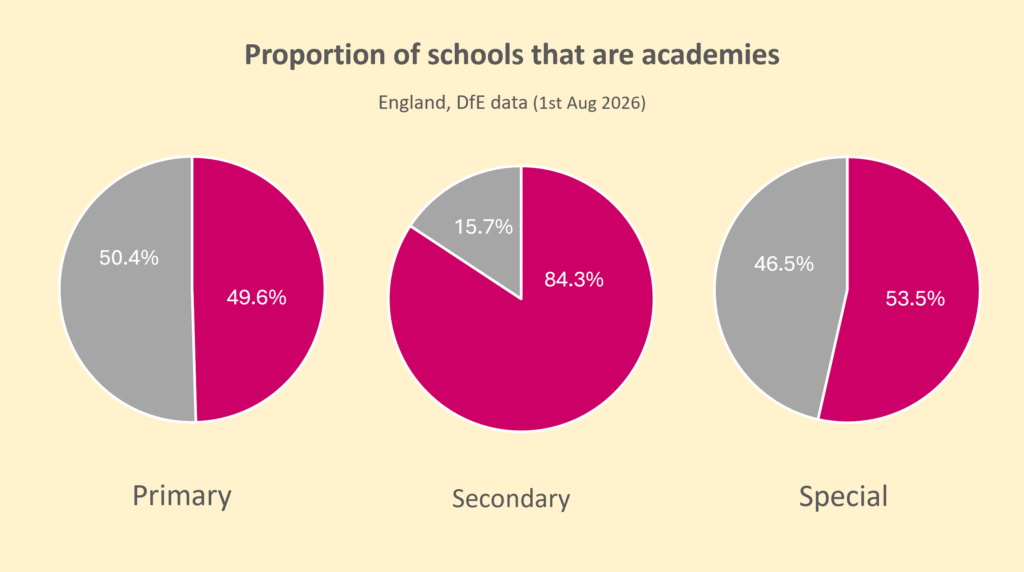
Conservative Ministers had wanted all schools to be academies by 2022 (Nicky Morgan MP) and then by 2030 (Baroness Barran), but both plans faltered. So, it’s unsurprising that the primary conversion rate has slowed.
The current government wants all schools to be in a trust, but has not set a deadline.
It is also exploring the idea of local authorities opening academy trusts. This single policy could cause academy numbers to explode.
3. Secondary academy schools
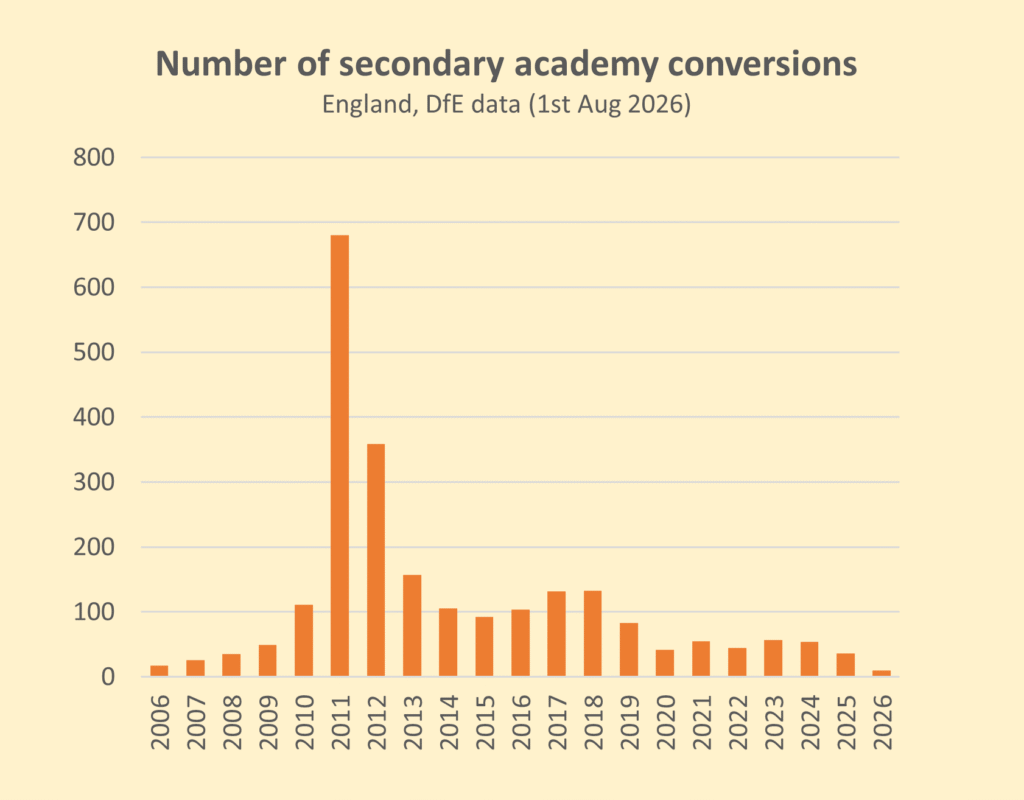
The secondary peak was 6 years before the primary & special school peaks. During the secondary peak in 2011 and 2012, almost a third of secondary schools converted in a two year period. This meant about a million more pupils attending an academy.
Only 15% of secondaries remain local authority (LA) maintained, so it’s understandable that fewer than 40 convert each year (and some of these may be academies that transfer into a new trust rather than new academies).
4. New special school academies
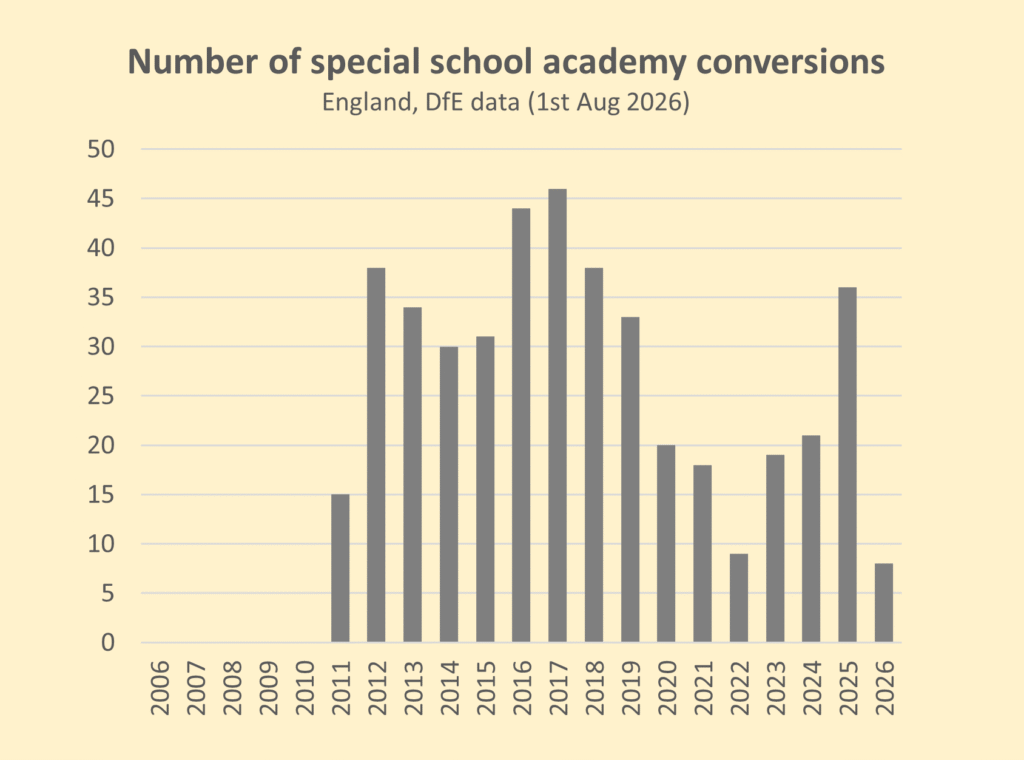
The special school picture is almost identical to primary:
- A later start.
- Highest numbers in 2017.
- A recent slowdown in the number of new academies.
5. Future growth of academy schools
Becoming an academy does not happen overnight and there are almost 400 schools in the DfE ‘pipeline.’ These schools are in the process of becoming an academy.
Looking at the pipeline indicates that any future growth will be mostly in the primary phase.
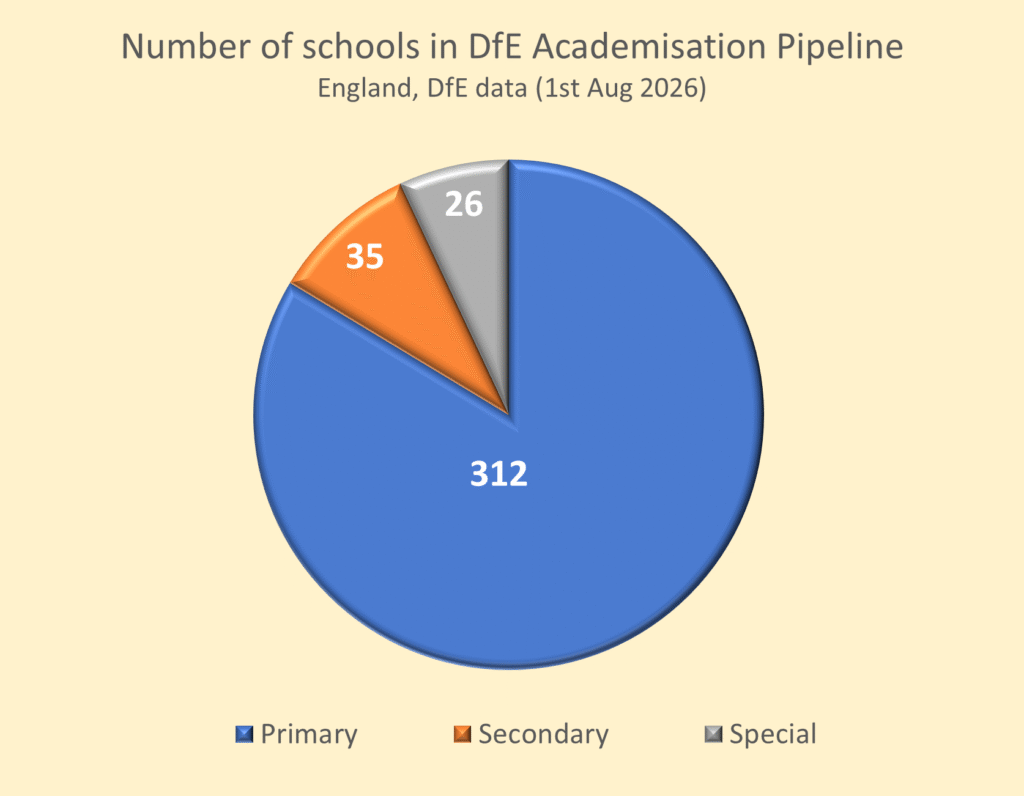
The number of secondaries who have not converted is small.
Some areas have no secondaries that are not already academies (e.g. Hull, Middlesbrough, Doncaster).
Of those secondary schools that remain LA maintained, some have chosen not to convert (e.g. King Edward VII in Sheffield where a campaign in 2023 stopped forced academisation).
Therefore, any growth will mostly come from the primary phase, where half of our 16,800 primary schools remain LA maintained.
6. What about academy trusts?
This graph shows the size of over 1,300 academy trusts (all trusts with fewer than 42 schools).
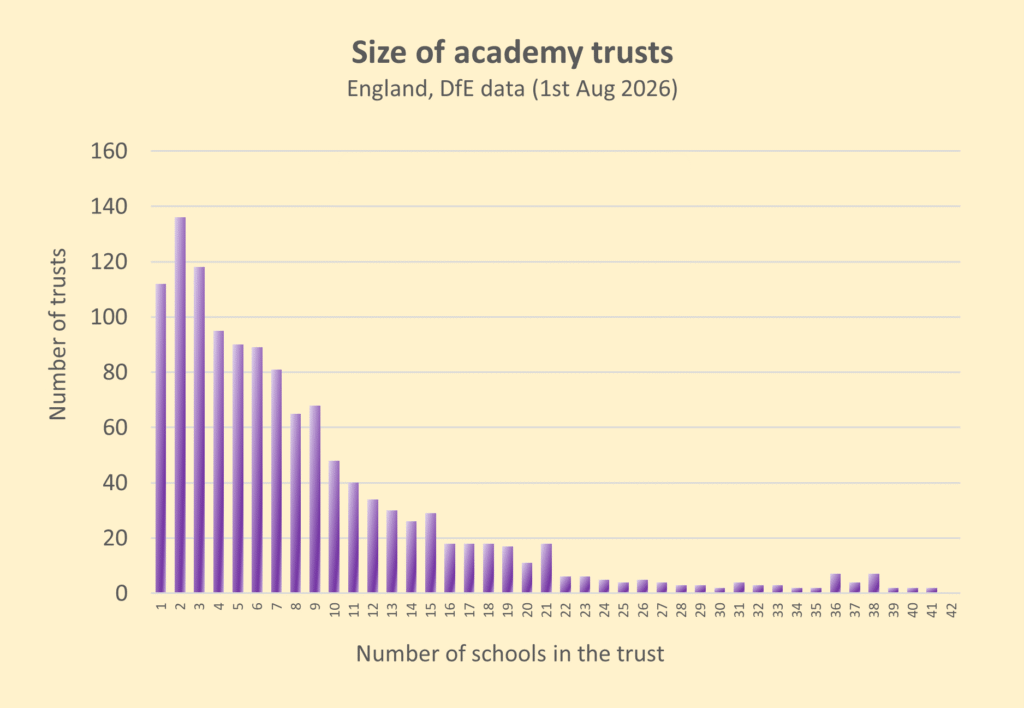
The most common trust size is 2 schools and 55% of trusts have 5 or fewer academies. Whilst the huge trusts pop up in the news more often, there are only a few dozen, whereas there are over 1,000 trusts with 10 or fewer academies.
It will be interesting to see how the size of trusts changes over the next five years. How many single-academy trusts will merge or be absorbed into a larger trust? Will medium sized trusts decide to stick within their region (and avoid expensive four hour round trips from HQ to far-away schools) or expand more widely?
7. The ten biggest multi-academy trusts in 2026
Here are the ten biggest trusts based on the number of schools in the trust.
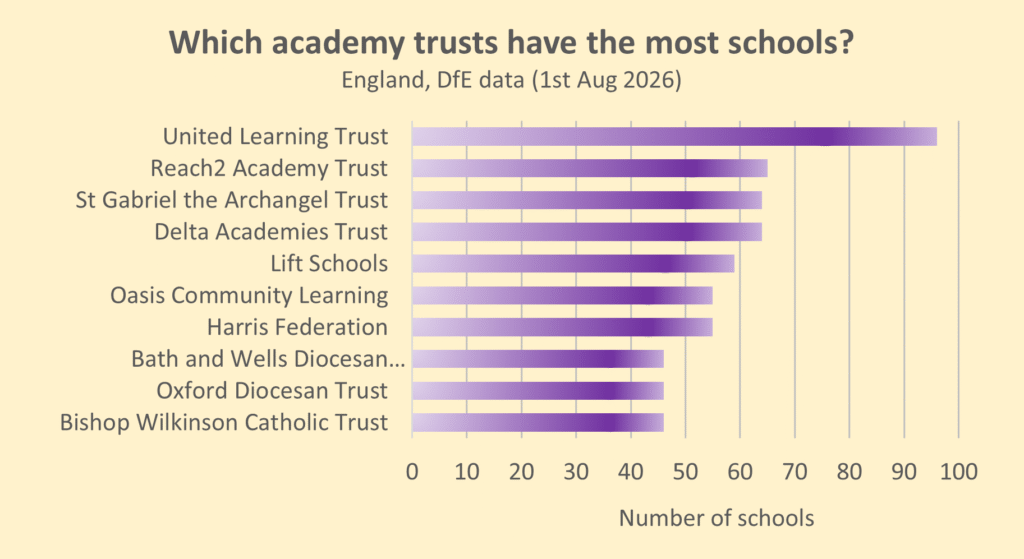
There are 16 trusts that have more than 40 schools. This group includes United Learning Trust which is the largest and has 96 academies. These giant trusts are still growing, albeit at a slower pace.
8. Opening new academy trusts
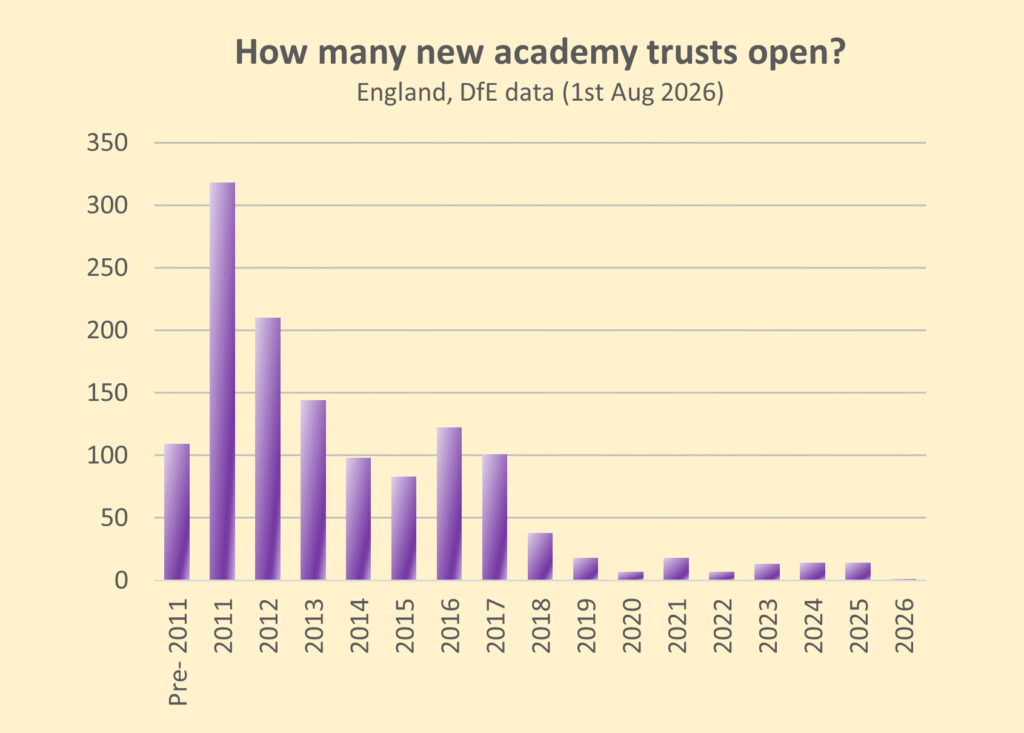
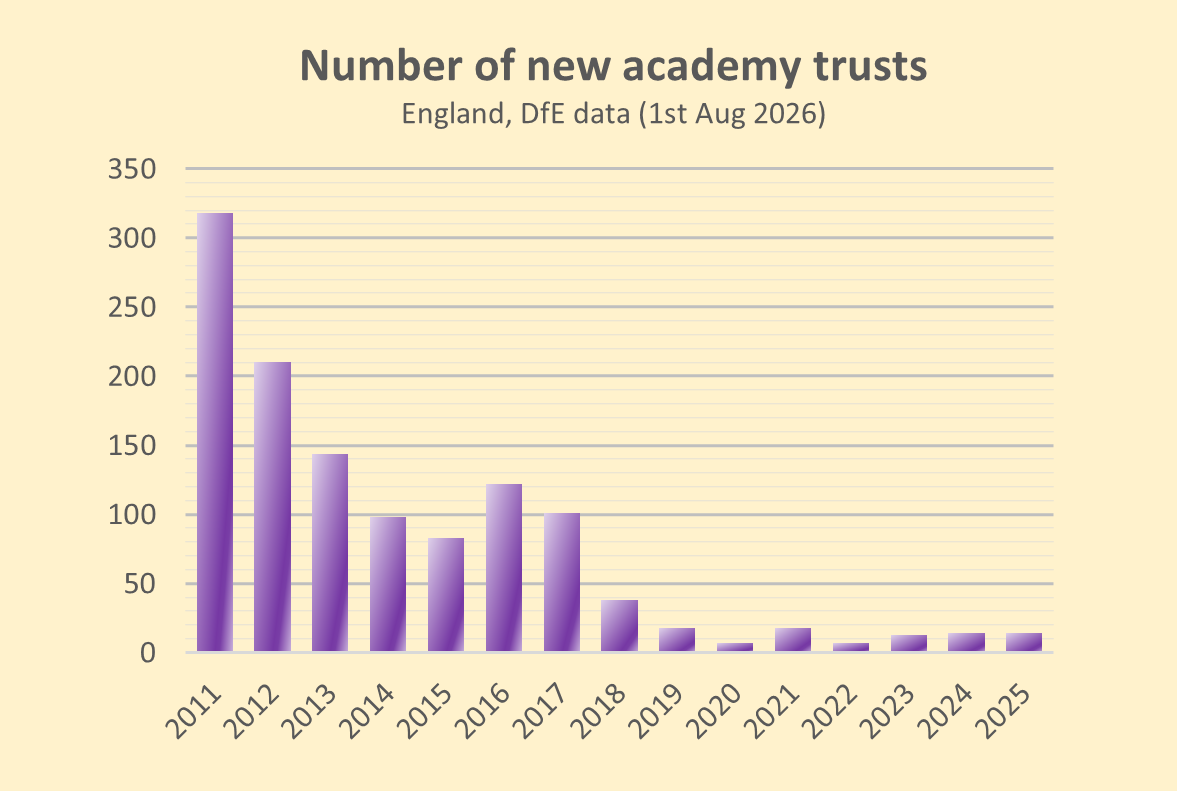
New trusts do open, but this is now uncommon. Each year, fewer than 20 new trusts open.
Generally, schools that become an academy will join an existing trust rather than launch a new academy trust.
Within recently formed trusts, there are several groups of faith schools that joined together under a new trust (e.g. Emmanuel Diocese in Warrington).
Typically, when trusts merge, one trust is wrapped into another and no new trust is opened. Whilst it is rare, some mergers create a brand new academy trust. For example, Eveleigh Link and Great Baddow trusts in Essex closed and launched as Quantum in 2025. The era of new trusts being created from LA-maintained conversions is over, but for occasional exceptions (e.g. Wulfruna Partnership in Wolverhampton).
9. What might affect future academy conversion rates?
- Government policy choices and direction.
- Schools converting to avoid closure as a result of falling birth rates.
10. So what for school leaders, governors and trustees?
If your school is maintained, you may face a big decision in the next few years. It is worth having internal leadership conversations to consider “what would we do if conversion became inevitable?”
That said, it seems unlikely that the current government will force all schools to be academies. The Conservative government proposed this and u-turned under pressure from their own backbench MPs. Labour ministers would likely face similar pressure from their MPs worried about ill feeling that comes from save-our-school campaigns.
If your trust is small, the consolidation question is worth asking now rather than later. Small trust does not equal bad, but with the onset of MAT inspections from 2027, it is important to ensure that any small trust has the leadership to be highly effective.
The future is always uncertain but smaller trusts look set to face more pressure as the sector matures. It’s better to plan for the future now. You may decide to remain a small trust (and that’s fine). You may decide to look for suitable partners to merge (and that’s fine).
One big wildcard is inspection of academy trusts. This may accelerate the growth (or demise) of some trusts. When that policy moves ahead, it could reshape all of the above landscape faster than anything we’ve seen so far.
More to read
Need help with inclusion in your council, trust or school?
- Check out our feedback or get in touch.
Keep up to date with inclusion from 9000 Lives
- BlueSky @9000lives.org
- LinkedIn Aaron-King-Inclusion
